|
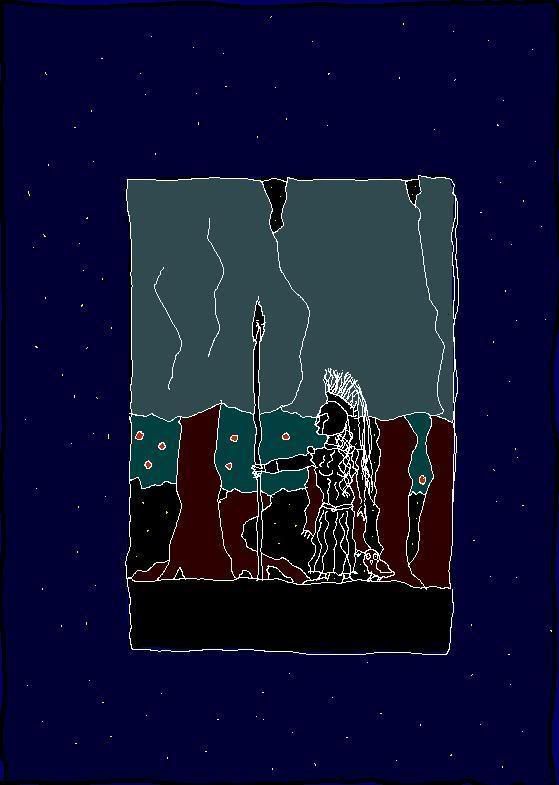
VI. The Unicorn Sikander was no longer beside the pool. His head throbbed. The ground seemed to swing and roll beneath him though he was lying quite still. He opened his eyes. Tall cypress trees soared into a clear quiet night sky above him, their tips moving gently in the lightest of winds. Beyond them the stars stood out clearly in a blue-black sky. The Sandragon could see the Milky Way, a glowing white river directly above. "Where am I ?" he wondered to himself, but no answer came. He looked around and saw that he was lying in the middle of a ring of dark cypress trees. Beyond them a grove of gnarled old trees with broad writhing trunks and heavy branches, loaded with fruit. The breeze carried him the scent of their oranges and lemons. A gentle slope lead down to the sea beyond. Sikander could just make out the water in the distance, as deep blue-black as the sky above, completely calm, moonlight shimmering on a silver pool. Water plashed softly, regularly on sand. "How did I get here?" Sikander wondered, and again there was nothing and no-one to answer him. He raised his head, but it span, so he rested it on his paws again and listened to the trees rustling and creaking. A small brown owl flew down out of nowhere and landed just inside the ring. It stared at the dragon with huge eyes, hopped a little to one side, stopped, fixed its stare on the Sandragon again. Sikander did nothing. "Hoo-hooo, Hoo-hooo," the little owl’s voice seemed hushed, questioning. Then Sikander heard a thundering noise of hooves in the distance, drawing nearer at a gallop. He felt the earth shake under the blows of the horse's hooves as it drew nearer. It burst into the ring - a white Arabian, long mane flying, nostrils flared, a wild light in its eye as it charged round and round the ring of trees. A long spiral horn grew from its forehead. It tossed its head and circled the dragon once, twice, three times. Then, as suddenly as it had appeared, the unicorn was gone and silence returned. Sikander turned to see if the little owl had flown away from all the noise and dust raised by the unicorn. But it was still there, staring straight at him. And beside it there stood a slim young woman, seeming to have appeared out of thin air. She wore a pleated white tunic reaching almost down to the ground, pinned at her shoulders with Gorgon-head brooches. Her face was almost completely hidden by the golden nose- and cheek-guards of a dark iron warrior’s helmet which bore a crest of long black horse-hair. The lady’s own dark hair curled out under the helmet in rings and waves tumbling down her shoulders, over the short leather cape draped at her back. She carried a javelin in one hand. Sikander could see that she had pale eyes set at a slant. They seemed to project an intensity which could not be hidden. The lady was not tall, but her proportions spoke of speed and grace of movement even as she stood quite still. She was smiling at Sikander, and her expression was at once mysterious and amused, cruel and detached. There was something about her that made the Sandragon ill at ease, as though he were an uninvited guest. "Welcome to my little island." At the kind words, spoken in a voice as clear and sweet as a bell, Sikander felt a wave of relief. He was about to reply, thanking her, but she spoke again with friendliness and authority: "Draw profit from your visit here, master Sikander. Many dream of coming, but few are so lucky. You have my sympathy in your quest and will have my assistance. Give me three questions and I shall give you three sure answers." Three questions. The trouble lay in the limit. Several were already on Sikander's mind before this strange warrior-woman had appeared. Where was he, how did he get here and what did this all mean? Three questions and three sure answers. The way the offer was made, it seemed like a chance not to be wasted. But what questions to ask? He could not keep the lady waiting for ever as he thought this over so he concentrated, then asked his first question: "Will the Phoenix die, then live again?" The warrior-woman replied without hesitation:
"The snake answered you truly: "How shall I find the Phoenix?" "Is that the truth?" Now the lady’s smile seemed to change imperceptibly, to grow a shade more cruel as she planted one end of her javelin in the ground and, holding it like a staff, glanced at the little owl before answering. "The truth. Now there is a question, good dragon. When the symbol, the sign, the word, links straight to reality, then truth is at hand. But reality, is that what lies before your eyes, under your hand, is that all you perceive, and no more? Then that is your truth. But how to decide when to believe your eyes? And how to believe what you perceive? And is there more? Is reality what lies in your mind? Beauty, elegance of conception, of structure, of construction. Utility, constance, reliability – are these true metres of the reality of ideas, beliefs, fears? Will they distinguish truth from illusion in your dragon-mind? Will you believe a dream is less real than the present? Will an illusion not on occasion provide you more and truer information than the report of your limited senses? Dear Sandragon, do you see how my questions are your answer?" This last question came with a laugh, both bitter and sweet - Sikander could not say which the stronger. Nor could he judge from the lady’s tone whether her last question was more of a taunt, a true question, or part of a true answer. Sikander still felt the earth swaying under his belly, his head spinning. He felt that none of this was real and a great tiredness came over him. He closed his eyes for a mere instant and when he opened them again there was no sign of the woman. The wind had grown stronger and made a rushing noise in the trees. The little owl opened its wings, hopped into the air and flew away. Sikander closed his eyes again. 
 |